
The Spanish poker legend Adrian Mateos won his first Poker Master event of the series to move into top spot…
Read MoreThe World Series of Poker has always been the tournament series of amateurs’ dreams. From the WSOP Main Event to other tournaments such as the Millionaire Maker, the Colossus and the Monster Stack, Las Vegas has played host to life-changing moments at Binion’s, The Rio and now both Horseshoe and Paris casinos.
The WSOP is where the Main Event changes lives. Sure, the lives of elite poker pros, but more so the lives of ordinary folk like you and me. Guys and gals who might make a dumb fold once in a while or misread six-four of diamonds as ace-king of spades. Recreational, amateur or novice players have often made the WSOP their personal playground over the years.
Since its inception in the 1970s, the World Championship has found underdogs and cast them into the bright light of superstardom. Amateurs have gone toe-to-toe with established professionals and come out ahead. We’ve found seven of the best Cinderella stories worth revisiting.
Chris Moneymaker – The Accountant Who Changed Poker Forever (2003)
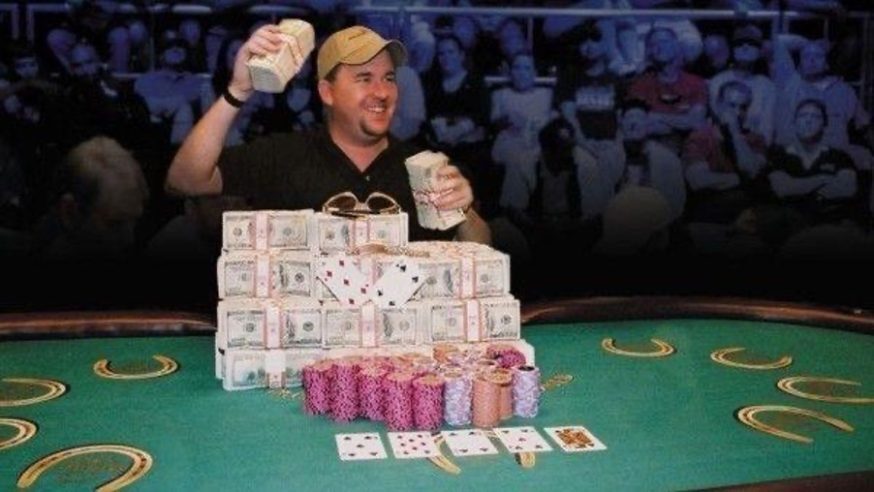
Few underdog stories have had a bigger impact on poker than Chris Moneymaker. The accountant from Tennessee was a recreational player when qualified online for the $10,000 WSOP Main Event through an $86 online satellite on PokerStars. It was Moneymaker’s first live tournament, as he entered the field of 839 players including some of the most respected names in the game.
Rather than being overwhelmed by the occasion, Moneymaker kept advancing, eventually knocking out future poker legend Phil Ivey on the final-table bubble thanks to a luck river. Moneymaker’s run to the final table was nothing short of a miracle, but he wasn’t finished, running over the established names before beating Sammy Farha heads-up.
Farha was a highly experienced cash-game specialist with a formidable reputation. Moneymaker’s victory became legendary for more than the $2.5 million first prize, and was remembered for a host of great hands. In one of the defining hands of the heads-up match, Moneymaker made a bold king-high bluff that helped cement his reputation as a player willing to challenge a professional on his own terms.
Defeating Farha to become world champion, Moneymaker’s televised run helped ignite an online poker boom. The Moneymaker Effect remains as influential today as ever, and perpetuated the notion that any ordinary player can qualify cheaply, compete with the elite and change their life in a single poker tournament.
Greg Raymer – The Patent Lawyer Who Beat the Poker Establishment (2004)

The Moneymaker Effect had already kicked in one year later when Greg Raymer arrived at a huge 2004 WSOP Main Event. Nicknamed ‘Fossilman’ because of his collection of fossils and distinctive fossil-themed card protectors, Raymer was a patent attorney and recreational player but with a serious understanding of the game.
Raymer navigated a total field of 2,576 entrants, more than three times the previous year’s total, to reach the final table. Proving his predecessor’s success was not a once-in-a-lifetime fluke, Raymer took on and beat heads-up opponent David Williams, who was a highly regarded young tournament player who previously excelled at Magic: The Gathering.
Raymer’s composed, analytical approach countered Williams’s aggressive style and eventually prevailed to win $5 million and the WSOP World Championship gold bracelet, as ‘Fossilman’ became the second consecutive Main Event winner to emerge from outside the established professional elite. Raymer’s win strengthened the idea that the WSOP was open to serious amateurs who studied the game, made good decisions and could withstand the enormous pressure of a championship final table.
Robert Varkonyi – The Last Amateur to Upset the Favorites (2002)

Before Moneymaker became the face of the amateur poker revolution, Robert Varkonyi provided an earlier example of an outsider winning the game’s biggest title. Varkonyi was a New York accountant who entered the 2002 WSOP Main Event and worked his way through a field of 631 players. In an era when the Main Event was still dominated in the public imagination by familiar professional names, his progress to the final table was a reminder that a relatively unknown player could survive the gruelling tournament and put himself in contention for the World Championship.
The final table gave Varkonyi an opportunity to beat not just a field of competitors, but the expectations surrounding who belonged at the top of poker. One of the memorable moments of the tournament came when Varkonyi eliminated Phil Hellmuth, who had wagered that he would shave his head if Varkonyi won the Main Event. Hellmuth honoured the bet, sitting in a barber’s chair after Varkonyi’s win to lose his locks on live television.
Jerry Yang — The Social Worker Who Won the People’s Championship (2007)

A psychologist and social worker from Temecula, California, Jerry Yang had only started playing poker seriously a couple of years earlier. He qualified for the $10,000 championship through a satellite tournament, investing just $225 to secure his place in a total field of 6,358 players, advancing through an enormous mix of amateurs and experienced professionals to reach the final table.
Yang’s victory was an emotional one. He pledged to donate ten per cent of his winnings to charity, and his tournament ended with a dramatic final hand against Tuan Lam. Yang made an inside straight on the river to secure the title and the $8.25 million first prize. His triumph showed that the amateur story was still more than alive, and that any player with a day job, a modest satellite investment and relatively little tournament experience could still win poker’s most prestigious event.
The combination of a remarkable result and a commitment to charitable giving made Yang a memorable champion.
Jamie Gold — The Hollywood Producer Who Defeated a Record Field (2006)

Jamie Gold was a television producer and talent agent rather than a conventional full-time poker professional when he won the 2006 WSOP Main Event. The tournament attracted an extraordinary 8,773 entrants, making it a landmark event in the poker boom, and a field that would not be outstripped for almost two decades.
Gold built a commanding chip position, often using table talk to tease weak play from fellow amateurs and pros alike. During the latter stages, Gold carried that momentum into the final table, where he faced several accomplished players, among them Allen Cunningham, already a multiple-bracelet winner and one of the most respected tournament professionals of his generation.
Gold’s table presence late on became the story of his win, as he constantly engaged opponents in conversation and tried to persuade them to call or fold. Some players found his approach irritating, while others considered it an effective way of gathering information and applying pressure.
Gold eliminated seven of his eight final-table opponents, eventually defeating Paul Wasicka heads-up when his pocket queens beat Wasicka’s pocket tens. The reward was $12 million, then the largest first-place prize in poker tournament history and still one that was only topped by Daniel Weinman’s recent $12.1 million victory. Gold’s success wasn’t about getting lucky at the right moment, but also about using his unconventional personality to unsettle experienced opponents for one tournament. And what an event it was.
Darvin Moon — The Logger Who Almost Upset the Odds (2009)

The late Darvin Moon’s story is one of the strongest underdog narratives in WSOP history, even though he finished second rather than winning the title. A self-employed logger from Maryland, Moon had never played a WSOP event before entering the 2009 Main Event. He qualified through a satellite at a casino in West Virginia and proceeded to outlast 6,494 entrants, including a collection of accomplished tournament professionals.
Moon’s down-to-earth manner and lack of interest in becoming a poker celebrity made him an appealing contrast to the young online professionals who were increasingly dominating the game, among them the youngest-ever champion in waiting, 21-year-old Joe Cada.
At the final table, Darvin Moon took out Phil Ivey, one of poker’s most feared players, to help secure his place heads-up against Cada. Moon seized the chip lead during the final duel, putting himself within reach of an $8.5 million victory. But Cada recovered and won the deciding hand with pocket nines against Moon’s queen-jack. Moon, ever the gentleman, won $5.1 million in second and raised Cada’s hand aloft as the youngest world champion in poker history.
Cada returned the favor in one of poker’s most touching moments. Moon, who has since passed away, had a huge effect on Cada, and while the amateur largely stuck to mid-stakes events the rest of his life, Cada went on to become one of the greatest ambassadors poker has ever had.
Qui Nguyen — The Low Stakes Cash Game Player Who Conquered the Pros (2016)

Qui Nguyen’s 2016 Main Event victory is a more modern example of an outsider taking on an exceptionally strong final table. The Vietnamese-American Las Vegas resident worked in a nail-salon business and played low stakes cash games, Nguyen had only a handful of prior WSOP results, with his biggest live tournament cash before the tournament being just $9,029.
Nguyen qualified for the Main Event through a $1,100 satellite and went on to survive a field of 6,737 players to a final table that included established professionals such as Cliff Josephy, Gordon Vayo and Griffin Benger. Rather than rely on patience like the passive Vayo, Nguyen played aggressive poker, applying pressure with large bets and raises, and built a substantial chip lead during the final stages. His heads-up battle with Vayo lasted around eight hours, with the two players trading chips before Nguyen finally secured the championship for just over $8 million.
Nguyen’s triumph challenged the assumption that the amateur would simply hang on and hope for good cards. Instead, Nguyen beat a talented final by taking the fight to them, using a fearless style that made him one of the most memorable Main Event champions of the modern era.
Did this article deal you a winning hand?